Thursday, May 26, 2016

May 7, 2016 Electronics on the boat

Today, Dave had a day of planning and set up for our electronics in the cockpit.  He had a few things he wanted to do at the same time.  There is a panel on the port side of the cockpit called the engine start panel.  It has the ignition, tachometer, fuel gauge, autopilot unit, and a 12 volt outlet. 
port panel

The fuel gauge hasn’t been working for awhile.  Since Dave has been filling our tanks “by hand” with 5 gallon jugs instead of at a fuel dock, he thought he could wait to fix it.  Dave had mounted a 12 volt outlet in this panel that also hasn’t been working.  And he wanted to exchange the autopilot unit with the depth meter unit that is on the binnacle (a column that has the steering wheel, a compass and instruments).  So today is what Dave called “a day of discovery”.  Kind of like exploratory surgery. 

 
The electronics are behind where you would sit on the port side.  So he had to empty the port lazarette to have access to the wiring.  The first thing he noticed was that the fuel gauge fuse was blown.  When he installed the 12 volt outlet, it had it’s own fuse.  He now can see that he installed it on the wrong side of the fuel gauge fuse, which was smaller.  So he replaced the fuel gauge fuse and will rewire the outlet with it’s own direct wire.  That way the outlet will have power all the time.  The way it was wired, it only had power when the engine was running.  We thought that would be OK, but the engine wouldn’t shut off if something was plugged in to that outlet.  We often charge our phones here while under way since we use our phone with the Garmin app with Active Captain (OK, sometimes we play solitaire).  The rewiring of the 12 volt outlet will be completed another day.


Next he looked into what he would need to exchange the autopilot control and the depth meter.  He didn't want to start that today because we were planning to move the boat again to the east side of the harbor.  We will be moving close to low tide.  The harbor is shallow, so we will want the depth meter to be functioning.  I won’t have as far to dinghy to shore for church on Sunday if we are on the west side of the harbor.  And the weather is no longer an issue. 
binnacle

He THINKS he has everything he needs to finish these projects. 

We ran the water maker for about 3 hours.  We used the Nextgen generator and it worked great today.  Yeah!!  I spent time cleaning the heads and floors. 
///electronics in cockpit

May 6, 2016 Boat day with Sailrite sewing machine

We were up and listening to Chris Parker’s weather forecast at 6:30 am.  We may get some squalls today or tonight, but it doesn’t sound bad.  Then it’s smooth sailing for awhile again. 

Dave got out our Sailrite sewing machine today.  The case is 10x13x20 inches and sits under our dinette table.  You do what you gotta do.  He wanted to make another sun protection cover for a fuel can.  So he took another old t-shirt, cut it apart and sewed it to loosely fit the can.  He wants to eventually get some material that will be sturdier and make covers that are more custom fit.  Anything that flops in the breeze will eventually be torn to shreds.  But his make shift t-shirt covers are doing just great for the time being.  He also patched the seam on one of our reusable shopping bags and reinforced all the side seams while he was at it.   When he finished, I had to give him a hard time by saying “you used white thread!?”  He also took up the shoulders on one of my tank tops that I consider a “boat shirt”.   It’s not the most esthetic alteration, but if anyone says anything, he said to proudly announce that it was sewn like a sail would be sewn.  So there!


This morning I prepared the pork steaks for our Wonderbag.  I browned each one, set them aside, sautéed some onion, added 2 cups of broth, put the pork back in the pot, simmered it for about 30 minutes with some seasoning, and put the whole pot in the Wonderbag by noon.  Then you let it sit with no additional heat source.

About a week ago, after our last company, the generator decided not to work again.  In the meantime, we have been using the Honda 2000 generator.  Dave decided to dig into the Nextgen generator today.  He found that the heat exchanger had debris in it and build up, like heave plaque on teeth.  So he took it apart and soaked the parts in vinegar, or any mild acid would work. 

Dave has a Folgers coffee plastic container that he uses for odd liquids or to hold parts when he is working on the boat.  It accidentally went overboard.  He yelled down into the cabin that he was going for a swim to fetch it.  Since we had the dinghy on the davits at the back of the boat, I asked him how he planned to get back into the boat.  It is right over our swim ladder.  The deck is about 5 feet above the water.   Once he thought through climbing back into the boat, he decided to put the dinghy in the water to go after it.  I told him we had another one on the boat that he could eventually have, but he wanted to go for a dinghy “joy ride”.   I started to call his bucket “Wilson” from the movie “the Castaway”.  So he called after the bucket “Folgie, come back.”  It was easy to pick up, then we went for our “joy ride”.  I compare our dinghy to having a convertible. 

We checked out the beach/shoreline.  I used the clear bottom bucket to check out the dark underwater areas.  Some were just areas of grass and some were coral or rocks.  We checked out our anchor.  By now it should be set really good, and it was, but it’s always fun to look.   
Then we just drifted for awhile, and Dave sorted through some of the anchoring equipment.  I just kept looking at what was under water.  It’s kind of like going snorkeling with out getting wet.  I am always fascinated by what is under us.

Back at the boat, Dave put the generator back together.  He also replaced the zinc at the end of the heat exchanger.  And it ran beautifully!  You really have to be mechanically inclined to live on a boat.  We didn’t want to overload it right away with the water maker, so we charged things and heated water.  That makes washing dishes so much easier.  The water heats whenever we run the engine, but after sitting a few days, it stays at room temperature.  So I usually heat water on the stove to wash dishes. 

Our pork dinner turned out fantastic.  I meant to take a picture when we opened the pot in the Wonderbag, but forgot.  After about 6 hours, the pan is still hot enough that you have to use a hot pad.  Dave made an awesome gravy from the broth and I filled in the rest of the meal.  Yum, Yum. 


May 5, 2016 Galley Day

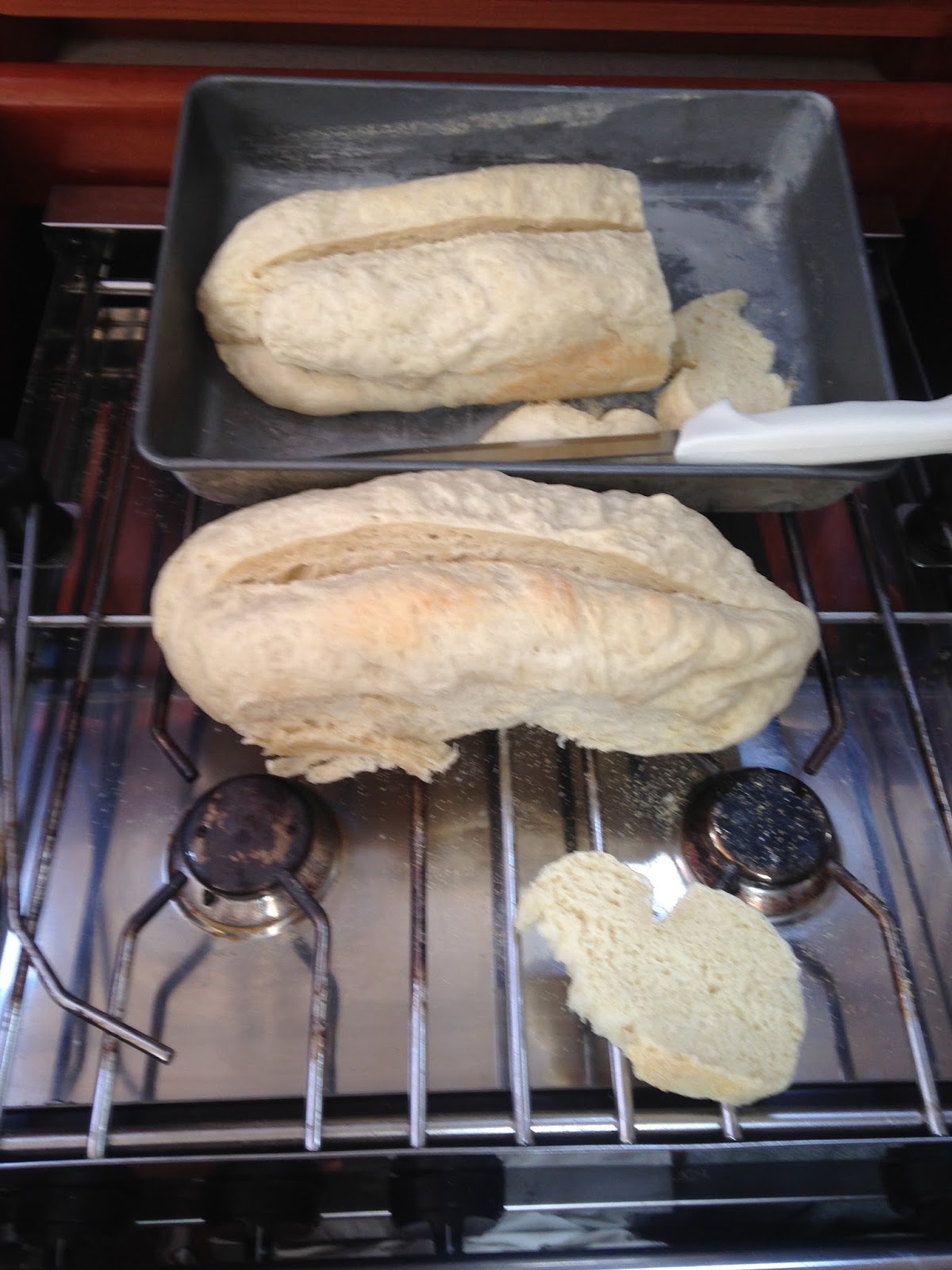
There are supposed to be 3 fronts moving through in 3 days, so we are staying put.  We spent the day cooking and reading.  I had soaked some red beans overnight.  So today, we cooked them and put them in a thermos to finish the cooking.  It doesn’t use any propane that way.  We tried a new bread recipe.  This one was on the package of the bread flour I had bought.  It was for a Rustic Italian bread.  We liked the way it mixed and the way it rose (can you use that for bread rising?).  It turned out great.  I would just tweak a couple things, but will definitely use this recipe and directions again.  Once we come up with a recipe and steps we are comfortable with, we will stick with it and start adding flavors.  I think it just has to become routine and we’ll quit buying bread for the most part. 

 
We were just talking about how unique it would be to invite other boaters over for homemade warm bread and jelly instead of for happy hour.   We know we would like it.

We thought we would cook the pork steaks and put them in our Wonderbag for 3-6 hours.  But they hadn’t thawed enough.  So we decided to cook a few on the grill tonight and the others tomorrow.  The red beans weren’t as soft as we thought they should be after several hours in the thermos.  So we cooked them a little longer and put them back into the thermos.  We’ll leave them overnight.  Then if they aren’t soft enough, they are just old beans and should be thrown away :(

I made tabouli salad with the fresh vegetables I bought yesterday along with feta cheese.  I had some fresh parsley on the boat that I bought at least a week ago.  I wasn’t sure if if was still ok, so we bought spinach to use if it wasn’t (no parsley at the store).  I had used part of the parsley in my aglio e olio pasta and wrapped the rest of it in foil.  It was still in great shape!  I have been wrapping my celery and decided to try it with fresh herbs.  So that is a tidbit I am going to to continue to do and to pass on to others.

We didn’t get any storms today.  And it was actually pretty calm this evening.  We enjoyed our grilled pork and salad outside with the company of 2 flies.  It’s been much worse at several outdoor restaurants in the Bahamas. 

May 4, 2016 Immigration, priovisions, and anchorage that is too close

We had a couple things to do on shore today.  Then we moved the boat to the western side of the bay for better protection from the west winds that were expected.  There were 3 fronts moving through with squalls and thunderstorms.  They may reach 50 k.  We rarely see anything over 25.  So we like to be in an area where the land will slow down the wind or at least the wave action on the water. 

First, we headed to the north end of the bay to the airport.  The Customs and Immigration office was there.  I had to extend my immigration by May 10.   You can’t ask for an extension until within a week of the expiration date.  The charts told us there was a dinghy dock at the airport, but we didn’t check it out the last time we were here.  There was a small dock right at the edge of a rock wall about 6 feet deep.  It was kind of windy, and the dingy would be rubbing against the rock wall if we tied to the dock.  We were glad we had Dave’s fancy anchoring system along.  We dropped a bow anchor out away from shore.  Then we backed up to the dock, climbed out, used the pulley rope to move the dinghy back out to the float on the anchor.  We were close enough that we just tied the pulley rope to the dock.  It is a nice way to keep the boat off the shore, but have the bow to the waves, so the waves don’t fill the boat by going over the stern transom.


After all that was accomplished, we walked up the gravel road and found the terminal as we cleared the trees.  We were happy it was right there, because it was hot and humid once we were off the water.  We found the office and had no problem with getting the extension.  Instead of asking for 60 or 90 days, I asked to match Dave’s date of June 26.  IF we are still here, at least we will ask for an extension together and not have to worry about different dates again.  That’s what I would do in the future, if I flew home again.  Try to match each other’s dates.  We made the passage over to Eleuthera just because of the Immigration office.  Otherwise we would have continued north along the Exumas. 
the road to the airport
airport with immigration

We went back to the boat to drop off our documentation folder.  We keep a binder with all of our papers and our passports.  We grabbed our garbage and headed to shore to provision.  We went to the main dock because we knew we could leave garbage there.  There is one further north, but it belongs to a restaurant.  We feel like we should give them our business if we are going to use it.  And it is harder to get to at low tide, which we had at the time.  We had a longer walk to the grocery store, but the walk feels great when you haven’t gone further than about 15 feet in a day or two.

It only took about 20 minutes to walk to the grocery store, not bad.  It was well stocked, but some things were pretty high priced.  The milk was $11/gallon.  The highest I have seen.  So we are sticking to our powdered Nido.  We wanted sour cream, so we paid almost $3 for 8 oz. (G”ot to weigh those wants vs needs).   The eggs were good, $3.15/dozen.  That was the main thing on our list.  I did pick up some apples, tomatoes, cucumbers and spinach and chips, lemons (didn’t have limes or these had aged and turned yellow).  The loaf of bread cost over $4 and was dry.  I wondered when I picked it up, and confirmed it with the first meal.  I guess I just need to get into a routine of making bread.  We did find a package of 10 frozen pork steaks for about $12.    We thought we should pick up some meat, since we haven’t had much luck fishing.   I don’t know how the locals afford their groceries.

We had our back packs and could easily carry everything back to the boat with us.  The wind was picking up and it was a bit of a rodeo getting back into the dinghy from the dock.  As I put the groceries away, Dave got the boat ready to move to the west side of the harbor. 

There were about 4 boats already anchored on the west side.  Dave sat out in the cock pit watching other boats arrive.  He watched as two trawler boats (power) came over to anchor near each other.  One was closer to a sailboat than what we would have been comfortable with.  The sailboat called the trawler on the radio, so we eaves dropped.  The sailboat told the trawler that he thought he was a little too close to his boat.  The trawler said he was comfortable with the distance and that his anchor never drags.  So the sailboat let it go. 

Dave and I then had a discussion about it.  And we have heard this complaint from other boaters.  The first boat in the anchorage kind of sets the rules for how the other boats will anchor (how much anchor rode or if you have set two anchors).  If we call a boat that is about to anchor too close for our comfort and they say they are comfortable, then what?  If we’re still not comfortable, do we would have to move.  You don’t want to get into an argument with them.  To say something along the lines of “we were here first” sounds like two kids on the playground.  And should there be an accident because they were too close, would your insurance company say “well, you should have taken precaution and moved”?  We are going to start quizzing other boaters about how they handle this.  There should be a polite way of getting your point across when they don’t get it on the first attempt.  Maybe something along the lines of: well we aren’t comfortable because………., so it would show good seamanship if you would just move …………instead of anchoring that close to us.”  ALSO, we saw these two trawlers at Long Island and we thought they had anchored a little close to us just so they could be together.  But the weather was fine, so we let it go.    If someone contacted us and said they weren’t comfortable with our anchorage, we would tell them we were sorry and move, or discuss why we thought it should be OK.  But to just say “well I am ok with it” and “my anchor never drags” seems a little selfish and naive.  There’s always a first time. 

We did get some rain before going to bed.  But the stronger winds didn’t hit until about 1:00am.  We didn’t think it was too bad.  Dave got up to take a look outside at everything and came back to bed.  If it had been worse, he would have stayed up.  We even leave our key in the ignition in case we had to move the boat suddenly.  I think we got off easy on this one.   And the two boats anchored close together actually got closer to each other when the wind direction changed.  Hmmm.
storm moving in

May 3, 2016 Warderick Wells, Exuma to Rock Sound Eleuthera

This morning we headed to Eleuthera.  So far the snubber is working fine and the hole in the side of the boat isn’t leaking.  Whew!

We left our anchorage at 8:30 am.  We had to actually go about 2 miles west before we could go north east to our destination.  We had to go around a sand bore to get to the cut between the islands.  We learned about sand bores last year.  They are described as fluid, shifting, live sand bars.  They constantly shift with the tide, so depths change.  You have to give that area a wide berth, since the depths can’t be charted.  In the Bahamas, there are many areas where they recommend VPR navigation-visual piloting rules.  That is when you are in an area with coral heads or rocks or sand bores and you have someone out on the bow helping you navigate through them.  We have done that several times.

Once we rounded the sand bore, we headed back east.  We went through the cut with an ebb flow.  That means the tide was going out and we could feel it moving the boat through the cut.  We had our main sail up and were motoring at an rpm that would normally move us at about 5-6 k, but we were moving at 10 k with the current.  It was like a speeding car for us!!  Wheeeee!  There was an area where the current flowing out was against the waves coming in causing “confused water”, but the winds weren’t too strong today and the cut was wide, so it didn’t seem as bad as some other cuts. 
going at the high speed of 11 k

We had a great east wind at about 15 k all day that made for a great sail to the northeast about 45 nm.  About noon, we decided to start the engine.  We were going to cross paths with a freighter.  So we powered up to cross in front of him while we had plenty of room to spare.  We could see his speed and destination on our AIS, automated identification system.  We noticed that he slowed down a bit when he saw what we were doing.  If there had been any doubt, we would have contacted him on the radio.  Or we would have passed behind him.  They always look much closer on the chart than in real life.  I’m not sure I would have been comfortable with crossing in front of him at night.  You never know if their boat is on autopilot or the skipper could be taking a nap. 
we are om tje cthe arrow to our left if a cargo ship
the ship is on the horizon.  Looked much closer on the chart

We crossed the Exuma Sound to get to Eleuthera.  It always amazes me when I see how deep it can be.   We’re talking 5000 ft at some points.  Dave noticed, as we approached the shore, in about a 50 foot stretch, we went from 1000 feet deep to 50 feet to about 20 feet.  That’s quite a shelf.  Other people usually catch fish along those shelves.  But not us!  Not a single bite today.  Actually, fishermen will track back and forth along the shelf.  So it’s real lucky if you catch a fish just crossing it. 

It  was about 3:45 when we entered Rock Sound Harbor.  But it was 4:30 by the time we anchored just outside of the town of Rock Sound about 5 miles in.  We made it in 8 hours.  It was a nice day on the water despite the fact that we didn’t catch any fish, AGAIN.  We spent a week here in March.  It is always a nice feeling when you anchor in a familiar place. 

May 2, 2016 Exuma Cays Land and Sea Park

 We decided to hike this morning and swim this afternoon.  May as well get hot and sweaty, then cool off in the water.  We took the dinghy to the park headquarters.  There is a $10/person user fee to enjoy the park, IF you stop into the office.  We thought it was worth $20 to support the park.  There are mooring balls here for $30/night.  I think they can accommodate more boats in the small areas near shore with the mooring balls, plus make some money.  We prefer to anchor. 

From the headquarters, we hiked across a beach to the trailhead for Boo Boo Hill.  At the trail head the sign reads:  The Lore of Boo Boo Hill
On a wild, stormy day many years ago, a luckless schooner sank off Warderick Wells.  All souls perished in the disaster.  Not a single body was recovered for a Christian burial.  Local people say that if you climb to the crest of the hill at the bloom of the full moon, you can hear the voices of the lost souls singing hymns.  Boo Boo Hill is named for the sounds of the ghosts. Either by the light of the sun or the glow of the moon, this trail shares with you some of the enchantment of the Exuma Cays Land and Sea Park.  

The trail was interesting over limestone rock, a creek bed at low tide, and sandy paths up the hillside.   It is a tradition to bring a piece of wood with your boat name and leave it on the top of the hill.  We knew this, but didn’t bother.  It was kind of tacky, but fun to look through.  We saw a couple signs from people we had met or seen at different anchorages.  The view was breath taking.  I believe the height was 60 feet.  You could see the length of the island, plus surrounding islands in the Exuma banks and out into the Exuma Sound.  And the water changes color with the depth.  So that was beautiful to see from above.  There were several blow holes, but it was close to low tide and not real windy, so we didn’t see any water spouting through them.  
 
trail


crossing the river bed at low tide as part of the trail


ocean side


blow holes with rocks to protect you from stepping into them


below the gift shop. the supplies for maintaining the mooring balls
We returned to our boat for lunch.  Then we took off snorkeling.  We had decided on two different areas.  There were 9 snorkeling areas around this island.  But some of them were in strong current or on the side with crashing waves.  We were able to tie our dinghy to a mooring ball to snorkel these sites.  The first one was called The Rangers Garden out in front of the park headquarters.  The ocean floor had many growths of coral spread out over a large area with some clusters of coral.  There were a variety of fish.  And I saw some large queen angelfish, my favorite.  I haven’t seen them this big since I first dove in Cozumel, Mexico about 20 years ago.  I also saw a huge manta ray circling the area.  He must have had a 10 foot wing span.  And there was a lobster whose tail alone had to be 12-15 inches long.  Usually they are tucked  under a ledge and you only see their spiny tentacles.  But he was sitting in the open.  I thought I would see larger numbers of fish, since it was a sea park.  But there was a nice variety of marine life and coral.

Next we moved the dingy to Emerald Rock.  It is a rock/island off the shore on the bank side of the island and closer to our anchorage.  There were groupings of coral near the island.  So we tied to a mooring ball on the one closest to the island.  Dave was having trouble with his  mask and had enough snorkeling.  So he waited in the dinghy while I explored this area.  Then I swam around the island with Dave following me in the the dinghy.  We have had trouble with currents before, so I didn’t want to be out of his sight.  The island had an overhanging shelf that was interesting to look under.  There were schools of fish hanging out in several areas.  But I didn’t see anything large, like a barracuda or a shark, which was just fine with me.  We love the weather this time of year for snorkeling.   You aren’t cold when you get out of the water, even sitting in a dinghy. 

We headed back to the boat for a relaxing evening.  We plan to get an early start tomorrow, so it was early to bed. 


.click to see video of BooBoo HIll

May 1, 2016 Black Point to Waderick Wells, Exumas

We had talked about moving the boat to Bell Island to have protection from the west.  But the bad weather may last until Saturday.  So we decided to go further north to Warderick Wells Cay.  We’ll spend a couple nights here, then go over to Rock Sound, Eleuthera for better protection from the wind and to extend my immigration permit. 

Warderick Wells Cay is the headquarters of the Exuma Cays Land and Sea Park.  This park is 22 miles long and extends 4 nautical miles on either side of the cays.  It includes 15 major cays and many tiny ones.    We had stopped at the northern end and the southern end last year and explored those areas.   We anchored at Warderick Wells last year, but only to stop for the night.  So I have always wanted to return to this area and explore it further. 

Before leaving this morning, Dave placed a screw in the hole in the hull and sealed it with butyl rubber.  This was a stronger patch than the butyl rubber alone. 

As Dave was removing our snubber off of our anchor chain this morning, the gate that closes over the metal clasp of the snubber came off in his hand.  He has another one on board and will replace it.  But he thought that was a good thing to happen while we were in calm seas instead of during the middle of a storm when it would be under stress.   The snubber is a rope with a clasp that goes from the deck to the anchor chain.  It takes the stress of the boat moving up and down with the wind and waves instead of the chain pulling on the windlass that is used to raise it.  So Dave was emphatic that this was a good thing to find now and not a bad thing.  (We weren’t going to go with the “bad things happen in 3’s” rule). 
the white rope is the snubber line connected to the anchor chain

Just before leaving our anchorage, we decided to stay on the bank side instead of going back out on the Exuma Sound.  We forgot how beautiful the water was with the different depths.  The water averaged about 15 feet in depth compared to over 1000 ft deep in the sound.  And we avoided going out and coming back in through the cuts between the islands.  Some of them can be tricky if you have wind and current opposing each other.  Not to mention the waves breaking over the rocks that make you nervous should you lose engine power for some reason. 

We had a beautiful sail all the way today.  It was only about 25nm.  The wind was about 15k and we sailed between 6.5-7.5k.  That’s faster than we can motor.  We were enjoying it so much, we almost turned around just to sail a little longer after we arrived.

We anchored by 1:30, had lunch, then went exploring.  We took the dinghy to the southern end of the island to snorkel in a channel between Warderick Wells and Hog Cay.  This area was know as a Pirate’s Lair at one time.  We snorkeled in search of Stromatolites.  Only trouble was, we forgot to google what they looked like before we left this morning.  And we weren’t near any wifi towers in the park.  So we never did find what we were looking for.  But we had nice swim.   I later read in our guide book that they are the oldest evidence of life on earth.  They are fragile flat grey reefs that date back 3.5 billion years.  They were thought to be extinct until discovered in the Bahamas in 1983.

 
Back in the dinghy, we explored a few other reefs that we will snorkel tomorrow.  We have a 5 gallon bucket with a plexiglass bottom to look under water.  It is like putting on a dive mask.  There weren’t very many boats anchored in this bay.  So we had a quiet night enjoying the sunset, again.